- Ottawa Jewish Archives
- Anne Frank Exhibit fonds
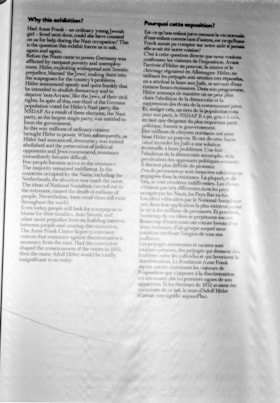
- 27 photos of the panels from "Anne Frank in the World" exhibit
27 photos of the panels from "Anne Frank in the World" exhibit
seriesMay 1992OJA 3-014-05-01
1 imageView at source ↗

Where
Not on the map yet.
Search for a place, or click the map, to drop the pin where the photo was taken. Street View follows the pin.
- Held by
- Ottawa Jewish Archives via Canadian Jewish Heritage Network (incl. Alex Dworkin Canadian Jewish Archives)
- Creator
- Elly Bollegraaf
- Dates
- May 1992 (indexed as 1992)
- Level
- series
- Extent
- 27 photographs b&w.
- Location
No place found in this description yet.
- Genre / form
- graphic material
- In the picture
- DocumentElectionExhibitionPoliticsPosterPrintedTagged automatically by a vision model; may contain mistakes.
- Text in the image
- Why this exhibition?Pourquoi cette exposition?Had Anne Frank – an ordinary young Jewish girl – lived next door, could she have counted on us for help during the Nazi occupation? This is the question this exhibit forces us to ask, again and again.Before the Nazis came to power Germany was afflicted by rampant poverty and unemployment. Hitler, exploiting widespread anti-Semitic prejudice, blamed 'the Jews', making them into the scapegoats for the country's problems. Hitler announced openly and quite frankly that he intended to abolish democracy and to deprive 'non-Aryans', like the Jews, of their civil rights. In spite of this, one-third of the German population voted for Hitler's Nazi party, the NSDAP. As a result of these elections, the Nazi party, as the largest single party, was entitled to form the government.In this way millions of ordinary citizens brought Hitler to power. When subsequently, as Hitler had announced, democracy was indeed abolished and the persecution of political opponents and Jews commenced, resistance immediately became difficult.Few people became active in the resistance. The majority remained indifferent. In the countries occupied by the Nazis, including the Netherlands, the situation was much the same. The ideas of National Socialism, carried out to the extremes, caused the death of millions of people. Nevertheless, these cruel ideas still exist throughout the world.Even today, people still look for a scapegoat to blame for their troubles. Anti-Semitic and other racist prejudice lives on, building barriers between people and creating discrimination. The Anne Frank Center hopes to convince visitors that resistance against discrimination is necessary from the start. Had this conviction shaped the consciousness of the voters in 1932, then the name Adolf Hitler would be totally insignificant to us today.Est-ce qu'une enfant juive menant la vie normale d'une enfant comme tant d'autres, est-ce qu'Anne Frank aurait pu compter sur notre aide si jamais elle avait été notre voisine?C'est à cette question directe que nous voulons confronter les visiteurs de l'exposition. Avant l'arrivée d'Hitler au pouvoir, la misère et le chômage régnaient en Allemagne. Hitler, en utilisant les préjugés anti-sémites très répandus, en a attribué la faute aux Juifs, se servant d'eux comme boucs émissaires. Dans son programme, Hitler annonça de manière on ne peut plus claire l'abolition de la démocratie et la suppression des droits de la communauté juive. Et, malgré cela, un tiers de la population vota pour son parti, le NSDAP. Il a pu, grâce à cela, en tant que dirigeant du plus important parti politique, former le gouvernement.Des millions de citoyens normaux ont ainsi hissé Hitler au pouvoir. Ils ont de cette façon laissé immoler les Juifs a une solution éventuelle à leurs problèmes. Une fois l'abolition de la démocratie accomplie, et la persécution des opposants politiques entamée, il devient plus difficile de protester.Peu de personnes se sont montrées solidaires en engagées dans la résistance. La plupart, et de loin, se sont montrées indifférentes. Les choses n'étaient pas très différentes dans les pays occupés par les Nazis, les Pays-Bas inclus. Les idées véhiculées par le National-Socialisme ont, dans leur application la plus extrême, coûté la vie à des millions de personnes. Et pourtant, beaucoup de ces idées se perpétuent encore. Beaucoup d'entre nous ont encore besoin d'un bouc émissaire, d'un groupe auquel nous puissions attribuer l'origine de tous nos malheurs.Les préjugés antisémites et racistes sont toujours présents, des préjugés qui dressent des barrières entre les individus et qui favorisent la discrimination. La Fondation Anne Frank espère avertir clairement les visiteurs de l'exposition que s'opposer à la discrimination est nécessaire dès les premiers signes de son apparition. Si les électeurs de 1932 avaient été conscients de ce fait, le nom d'Adolf Hitler n'aurait rien signifié aujourd'hui.cjhn.caRead automatically; may contain mistakes.
- Access & use
- ALL PHOTOS ARE COPYRIGHT OF ELLY BOLLEGRAAF. PHOTOS CANNOT BE PUBLISHED OR USED WITHOUT CREDITING ELLY
- Harvested
- 2026-10-17T20:12:43Z · source datestamp n/a · cjhn
Digital objects at the source
- imageOpen original at source ↗3-014-05-01.jpg