- Museum of Jewish Montreal
- National Radical School
National Radical School
collection1913-2004
9 of 22 descriptions below digitizedOpen enclosing description at source ↗
This description was harvested from its parent's finding aid, but the source catalogue gave no direct link for it. The link opens the nearest enclosing description; look there for National Radical School.
Digitized below this collection
9 images · displayed from Museum of Jewish Montreal's own server
 Letter on illustrated letterhead from the Peretz School delegate to the 1st Canadian Jewish Congress Plenary Assembly, 1919
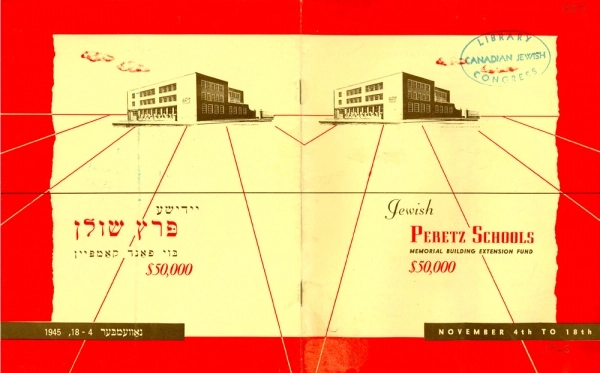 Peretz School Fundraiser Booklet, 1945
 Inauguration of the addition to the Peretz School building, ca. 1942, Duluth Street
 Bialik High School graduation, ca. 1976 [Name of speaker not provided]. Yaacov Zipper and Nahum Wilchesky in background
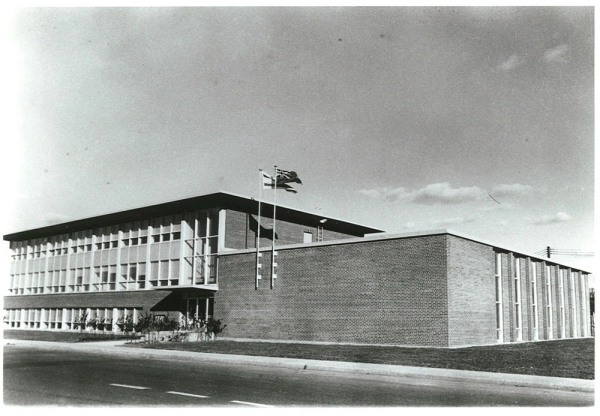 Jewish Peretz School in 1959 at its new location on Wavell Road
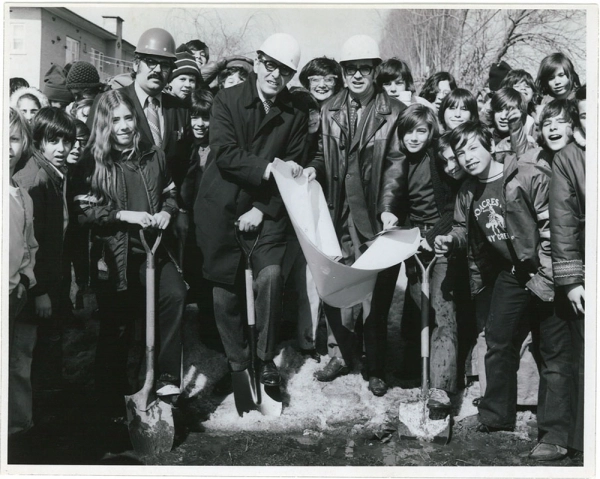 Bialik High School sod turning ceremony, 1972
 Students performing Israeli folk dancing at Bialik High School graduation, ca. 1976
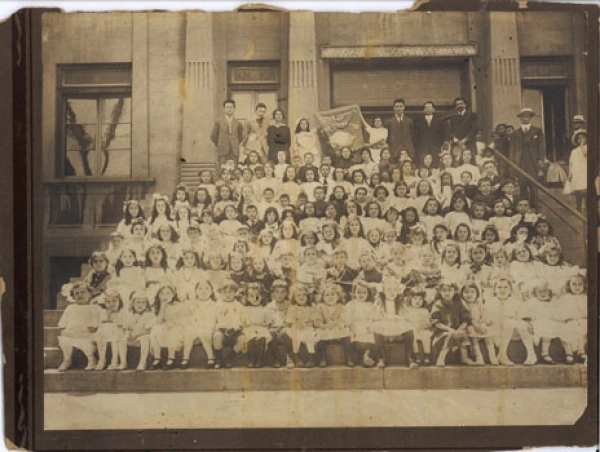 Group portrait of Jewish students (maybe from the National Radical School), Baron the Hirsch Institute, Bleury Street, Montreal, 1913
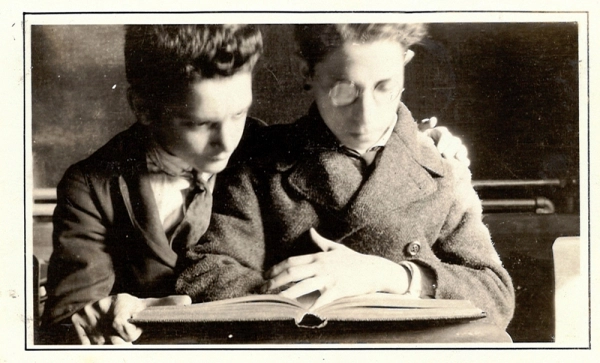 Two children sharing a school book, National Radical School, c. 1913-1919
Where
Not on the map yet.
- Held by
- Museum of Jewish Montreal via Museum of Jewish Montreal — map of Jewish Montreal
- Creator
- Marian Pinsky
- Dates
- 1913-2004 (indexed as 1913–2004)
- Level
- collection (source: Story)
- Extent
- 13 places
- Scope & content
- Funded by a coalition of Jewish radical and Poale Zion (Labour Zionist) groups, the National Radical School was a secular alternative to the traditional synagogue schools of the 1870–1910s and the Talmud Torah system. Opened in 1913, it emphasized on social justice and Yiddish language and literature which distinguished it from its contemporary, the Jewish People’s School (Yidishe Folks Shule), where Hebrew and Yiddish were given equal attention. As a political party, the Poale Zion in Montreal sought to establish a school that would follow its ideological convictions. Intense discussions in 1911 regarding the status of Jewish education in Montreal led to the opening of the National Radical School two years later. Laiser Zukor, who would become its president, was influential in providing the school’s funding base. Disputes over ideology and the language of instruction occurred almost immediately, leading to the breakaway Jewish People’s School in 1914, which had stronger ties to Zionism, supported more Hebrew instruction, and placed a greater emphasis on Jewish tradition, including religious tradition.. The National Radical School remained firmly Yiddishist and focused on literature and left-leaning ideology. The National Radical School, renamed the I.L. Peretz Shule in 1918, in recognition of the great Yiddish poet, provided an after-school program for Jewish children attending Protestant public schools. At the axis of intra-communal debates between the more assimilated “uptowners” and Yiddish-speaking immigrant “downtowners,” the Peretz Shule provided a cultural and educational milieu for Yiddish enthusiasts, and bolstered “downtowner” efforts for a separate Jewish school system. Moving to a renovated factory on Duluth Avenue, the Peretz Jewish day school opened in 1942 and was soon populated by children of Holocaust survivors. Inspired by the enthusiasm of Principal Yaacov Zipper, many of the initial teachers were volunteers. The school remained on Duluth until 1960 when it moved to Wavell Road in Côte-St-Luc following the westward migration of the Jewish community. Zipper served as the Peretz Shule principal for 50 years and was one of Canada’s key contributors to Yiddish culture. His dedication to preserving the rapidly disappearing language in the face of assimilation was challenged as he struggled to mobilize the community’s financial support. In 1971, Zipper reluctantly assented to the amalgamation of the Peretz School with the Jewish People’s School, which created the Jewish People’s and Peretz School (JPPS) and led to the opening of Bialik High School in 1972. The school set about maintaining a delicate balance between Hebrew and Yiddish instruction alongside a comprehensive secular curriculum. JPPS-Bialik remains one of the few Jewish day schools in the world that teaches Yiddish language and culture. Along with the Yiddish Theatre and the Jewish Public Library, JPPS-Bialik makes Montreal’s Jewish community’s commitment to the Yiddish language quite extraordinary. Compiled by Marian Pinsky. Sources: August, David. The Genesis Period of the Jewish People's School in Montreal. Montreal: Concordia Univeristy, 1975. Masters Thesis. Belkin, Simon. Le Mouvement Ouvrier Juif Au Canada (1904-1920). Trans. Pierre Anctil. Sillery: Septentrion, 1999. Butovsky, Mervin, and Ode Garfinkle. "In Defense of Yiddishkeit: The Journals of Yaacov Zipper, a Selection: 1950-1972." Association for Canadian Jewish Studies 9 (2001): 124-54. Novak, Hershl. La Première École Yiddish De Montreal, 1911-1914: Baym Onhayb. Trans. Pierre Anctil. Quebec: Septentrion, 2009. Rome, David. The Heroes of Montreal Jewish Education. Montreal: National Archives, Canadian Jewish Congress, 1992. Rosenberg, Michael. Ethnicity, Community, and the State: the Organizational Structures, Practices and Strategies of the Montreal Jewish Community's Day School System and Its Relations with the Quebec State. Ottawa: Carlton University, 1995. PhD Dissertation. Shapiro, S. "The Beginning of the Jewish People’s School." Pages for Jewish Education 1 (1962). Wiseman, Shlomo. "The Jewish People’s School of Montreal." Journal of Jewish Education 20.1 (1948): 58-63. Zipper, Ya’akov. The Journals of Yaacov Zipper, 1950-1982: the Struggle for Yiddishkeit. Montreal: McGill-Queen's University Press, 2004. *Images courtesy of the Jewish Public Library Archives and the Canadian Jewish Congress Charities Committee National Archives.
- Location
No place found in this description yet.
- Subjects
- Education
- Language
- English
- Harvested
- 2026-10-17T06:33:50Z · source datestamp n/a · mjm