- Museum of Jewish Montreal
- Montreal Hebrew Orphans’ Home
Montreal Hebrew Orphans’ Home
6 of 10 descriptions below digitized
This description was harvested from its parent's finding aid, but the source catalogue gave no direct link for it. The link opens the nearest enclosing description; look there for Montreal Hebrew Orphans’ Home.
- Held by
- Museum of Jewish Montreal via Museum of Jewish Montreal — map of Jewish Montreal
- Dates
- 1909-1942 (indexed as 1909–1942)
- Level
- collection (source: Story)
- Scope & content
- The Montreal Hebrew Orphans’ Home opened in 1909 on 18 Evans Street. Despite its name, the home initially took in transients and the elderly as well as orphans. At the time, the term orphan did not necessarily mean a child without parents--many children of impoverished single parents were also categorized as such. In the context of massive Jewish immigration from Eastern Europe, the existing Jewish community arranged to provide support to the predominantly poor new migrants. Furthermore, juvenile delinquency was a very present reality at the beginning of the century, and was often associated with “foreigners” and immigrants. The Jewish community therefore organized itself to deal with these problems, creating agencies such as the Juvenile Aid Department and the Neighborhood Settlement House. In this context, the Baron de Hirsch Institute was a pioneer in providing services for Jewish inhabitants of the poor downtown area, and it helped establish the Orphans’ Home. In 1921, the home was forced to relocate to larger facilities at 500 Claremont Avenue. The number of Jewish orphans in the city was rising, and the Federation of Jewish Philanthropies and other Jewish community groups collected funds for the new home, which had improved accommodations and a school. The orphanage’s school taught traditional Jewish prayers, ethics, and the Hebrew language. It also taught its residents to prepare Jewish meals in an effort to pass on traditions normally acquired from parents. The orphans spent summers at a camp in the town of Shawbridge, where they could get fresh air and recreation. In 1922, while many children were in Shawbridge, fire struck the camp, killing 12 of the vacationing children. The deceased children were buried in one mass grave at the Shaar Hashomayim Cemetery on Mount Royal. The Montefiore Orphans’ Home, originally located on Jeanne Mance, opened in 1918. Like the Montefiore Club, the orphanage was named after the famed British Jewish philanthropist, Sir Moses Montefiore. This second home merged with the Montreal Hebrew Orphans’ Home in 1936, again accommodating an increasing number of orphans. However, by the 1940s, the orphanages were forced to close due to lack of funding and the rise of foster care in Quebec. Many of the children who were raised at the orphanages were integrated into the community and grew up to become active members. They continued to hold alumni events for years. Compiled by Valérie Beauchemin and David Gilbert Sources: Gordon, Judy. Four Hundred Brothers and Sisters: Two Jewish Orphanages in Montreal Quebec, 1909-1942. Toronto: Lugus, 2002. Gordon, Judy. Four Hundred Brothers and Sisters: The Story Continues. Toronto, ON: MJ Publications, 2004. Shuchat, Wilfred. The Gate of Heaven: The Story of Congregation Shaar Hashomayim of Montreal, 1846-1996. Montreal: McGill-Queens University Press, 2000. 89. *Images courtesy of the Myer and Judy Gordon Collection of the Canadian Jewish Congress Charities Committee National Archives and the Jewish General Hospital Archives.
- Location
No place found in this description yet.
Where
More details
- Creators
- Valérie Beauchemin; David Gilbert
- Extent
- 4 places
- Subjects
- Communal
- Language
- English
- Harvested
- 2026-10-17T06:33:24Z · source datestamp n/a · mjm
Original metadata
As harvested (mjm)
Digitized below this collection
6 images · displayed from Museum of Jewish Montreal's own server
 1924 outing. From the Myer and Judy Gordon Collection, CJCCCNA
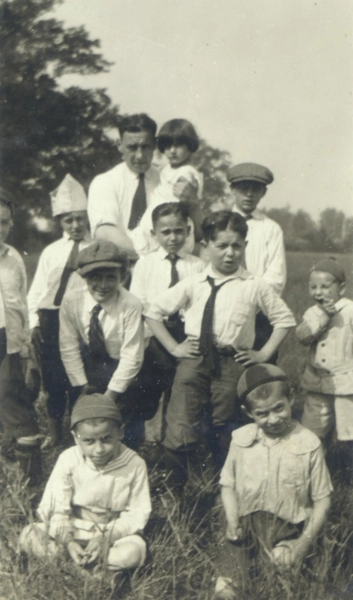 Montefiore Hebrew Orphans’ Home children on a country outing, 1924, with staffer Alexander Rajinsky. From the Myer and Judy Gordon Collection, CJCCCNA
 Orphans and volunteers from Montefiore Hebrew Orphans’ Home on an outing, 1924. From the Myer and Judy Gordon Collection, CJCCCNA
 Group of boys from Montefiore Hebrew Orphans’ Home, circa 1925. From the Myer and Judy Gordon Collection, CJCCCNA
 The Montreal Hebrew Orphans’ Home located on Claremont Avenue, after having moved from Evans Street in 1921. Reproduced in The Jew In Canada, 1926
 This photograph depicts the first location of the Montefiore Orphans’ Home (1918-1936) located on Jeanne-Mance