- Museum of Jewish Montreal
- Neighbourhood House
Neighbourhood House
collection1927-1964
6 of 10 descriptions below digitizedOpen enclosing description at source ↗
This description was harvested from its parent's finding aid, but the source catalogue gave no direct link for it. The link opens the nearest enclosing description; look there for Neighbourhood House.
Digitized below this collection
6 images · displayed from Museum of Jewish Montreal's own server
 Portrait de groupe, dance au « Neighbourhood House », Montréal, 1960. Avec l’aimable permission des Archives de la Bibliothèque publique juive
 Portrait de groupe, enregistrement, « Neighbourhood House », Montréal, vers les années 1950
 Portrait de groupe de deux jeunes enfants nageant pendant qu’un troisième regarde au fond, « Neighbourhood House », Montréal, août 1955
 Prise extérieure, des enfants assis dans un stationnement habillés comme des Amérindiens, « Urban Camp », « Neighbourhood House » vers les années 1950
 Portrait de groupe de membres debout à l’extérieur de « Neighbourhood House » avec des traîneaux tirés par des chevaux, programme d’hiver, Montréal, vers les…
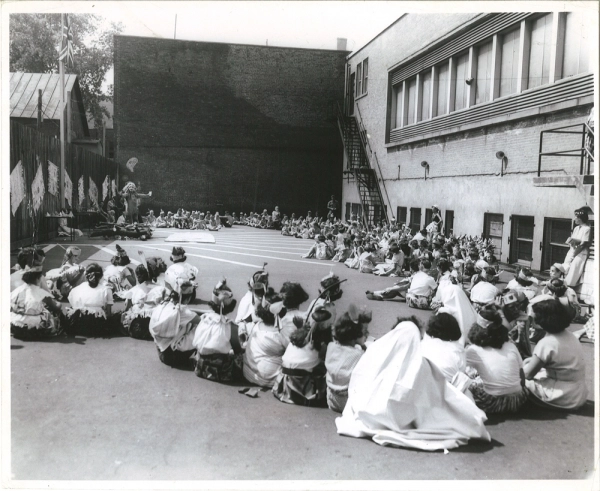 Prise extérieure, des enfants assis dans un lieu de stationnement habillés comme des Amérindiens, « Urban Camp », « Neighbourhood House », vers les années 1950
Where
Not on the map yet.
- Held by
- Museum of Jewish Montreal via Museum of Jewish Montreal — map of Jewish Montreal
- Creator
- Marian Pinsky
- Dates
- 1927-1964 (indexed as 1927–1964)
- Level
- collection (source: Story)
- Extent
- 4 places
- Scope & content
- An important community centre for Eastern European Jewish immigrant children for almost forty years, the Neighbourhood House was considered not only the place to “go,” but the place to “grow.” Opening in 1927 at 3958 Laval Avenue to combat what the Jewish community saw as a pervasive problem of juvenile delinquency, the Neighbourhood House served as a social, educational, cultural, and recreational centre for children living in the surrounding area. Problems of delinquency were disproportionate to the community’s population; McGill sociologist Herman Ross claimed that “Hebrews” made up 7.19% of juvenile court cases but only 4.8% of the city’s population, attributing this anomaly to the “sub-standard parenting” of immigrant parents. A “Jewish-community problem” therefore necessitated a “Jewish community response.” As a project established to keep adolescents off the street and assist their integration into the community, the House became a constituent agency of the Federation of Jewish Philanthropies in 1928. The Neighbourhood House served not only as a preventative agency, but also provided youth with a refuge to avert “anti-social tendencies.” Catering to children of a variety of ages, the impressive array of extracurricular activities included sports, a nursery school, day camp, informal education programs, scouts, discussion groups, a lending library, as well as sewing, dancing, music, and woodwork classes. The provision of English classes was also a priority, performing an important assimilating function for young Eastern European Jewish immigrants and their children. While emphasis was placed on enhancing Jewish experiences through recreational and educational activities such as Purim and Hanukkah festivals, non-Jews were also welcomed in the Neighbourhood House programs, composing 7% of its membership. The Neighbourhood House was initially located in the home of its honourary president, Lionel Sperber through the mid-1940s. It was then briefly relocated to the basement of the Old People’s Home on de l’Esplanade. A fundraising campaign launched in 1947 led to the purchase of the building on 4440 Clark, which would remain the centre of activities through 1960. The Neighbourhood House also maintained a nursery school in the 1960s on Jeanne-Mance, in the same building as the former Montefiore Hebrew Orphan's Home and Herzl Dispensary. The institution eventually followed the migration of the Jewish community westward in the early 1960s when it moved to Côte-des-Neiges. Its dedicated case workers, staff, and volunteers invested much time and energy in the activities, recognizing their responsibility for shaping future citizens. The “second” Neighbourhood House, located at 3130 Linton Avenue and later at 6645 Darlington, was co-sponsored by the National Council of Jewish Women to help integrate French-speaking Sephardic Jews arriving from North Africa in the 1960s. The Neighbourhood House affiliated with the Snowdown YM-YWHA in 1965 and became the Centre Communautaire Juif in 1971 catering to the needs of Montreal’s growing Sephardic population. It would remain on Darlington until 1980. Compiled by Marian Pinsky. Sources: Gordon, Judy. Four Hundred Brothers and Sisters: The Story of Two Jewish Orphanages in Montreal, Quebec 1909–1942. Toronto: Lugus Publications, 2002. Khalfa, Joelle. “À la decouverte de mon âme communautaire.” 50 ans ensemble: Le livre Sepharade 1959–2009. Ed. David Bensoussan. Montreal : Communaute Sepharade Unifiee du Quebec. 2010. 178–79. Levy, Joseph J. and Leon Ouaknine. “Les institutions communautaires: des Juifs marocains à Montreal.” Les Juifs du Maghreb: Diasporas contemporaines. Ed. Jean-Claude Lasry and Claude Tapia. Montreal: Les presses de l’Universite du Montreal, 1989. 55-78. Myers, Tamara. “On Probation: The Rise and Fall of Jewish Women’s Anti-delinquency Work in Interwar Montreal.” Negotiating Identities in 19th- and 20th-Century Montreal. Ed. Bettina Bradbury and Tamara Myers. Vancouver: UBC Press, 2005. Neighbourhood House Joint Study Questions for Committee’s Consideration. Committee Representing Federation [of Jewish Community Services]: Chairman, S. Samuelsohn, members Eddie Barkoff, Zave Levinson, Irving Riddell, A. H. Jassby, David Kirsch, Phil Garfinkle. Committee Representing Neighbourhood House: Chairman Arthur Pascal, Members George Shuster, Lionel A. Sperber, Ruth Kirsch, and Edward Feigin. Report submitted May 1954. Shriar, Rupert. “Story of a ‘House.’” Canadian Jewish Chronicle, 17 Feb. 1950. 5. Yelin, Shulamis. Shulamis: Stories from a Montreal Childhood. Montreal: Vehicule Press, 1984. *Images courtesy of the Jewish General Hospital Archives and Jewish Public Library Archives.
- Location
No place found in this description yet.
- Subjects
- Communal
- Language
- English
- Harvested
- 2026-10-17T06:33:36Z · source datestamp n/a · mjm