- Museum of Jewish Montreal
- Rabbinical College of Canada
Rabbinical College of Canada
collection1941-2015
10 of 13 descriptions below digitizedOpen enclosing description at source ↗
This description was harvested from its parent's finding aid, but the source catalogue gave no direct link for it. The link opens the nearest enclosing description; look there for Rabbinical College of Canada.
Digitized below this collection
10 images · displayed from Museum of Jewish Montreal's own server
 Portrait de Menashe Lavut, qui a fondé le premier groupe Hassidique à Montréal approximativement en 1910
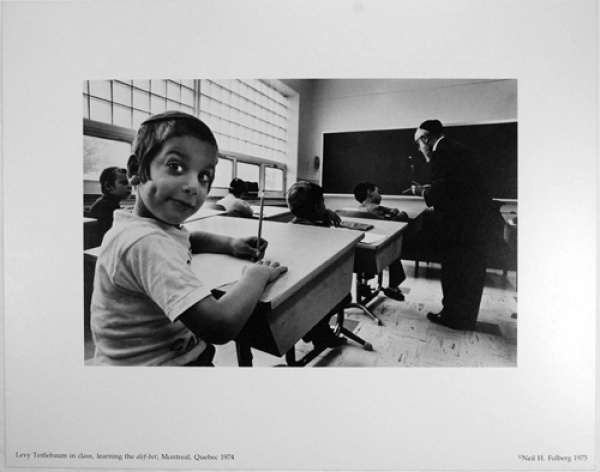 Photographie : {2008. 8.1.9} « Levy Teitelbaum en classe, apprenant l’alef-bet; Montréal, Québec 1974 » de “Portfolio One: We Are They People” de Neil Folberg…
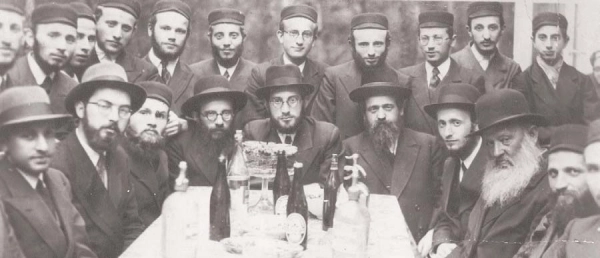 Des étudiants Lubavitch du yeshiva en Otwock, Pologne, une banlieue de Warsaw, durant le printemps de 1938, à l’aube de l’Holocauste
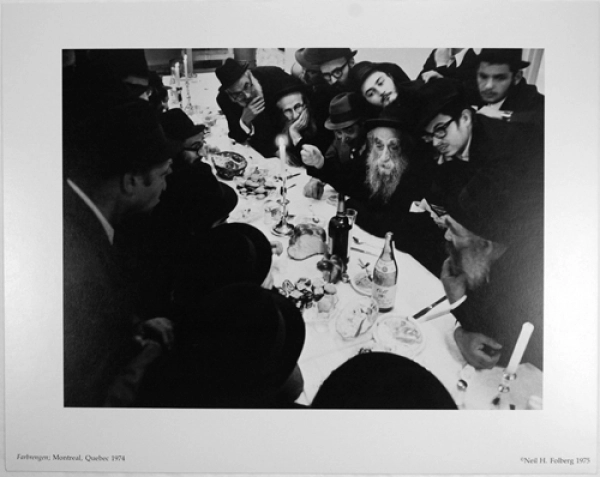 Photographie: (2008. 8.1.7) “Farbrengen; Montréal, Québec 1974” de “Portfolio One: We Are Thy People” de Neil Folberg (Berkeley, CA, 1975)
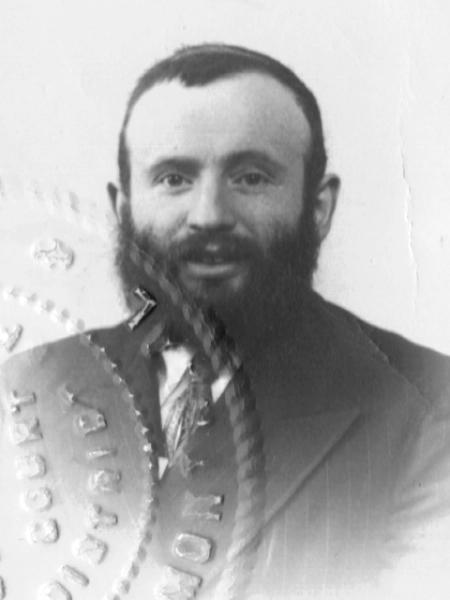 Photo du passeport polonais du rabbin Aryeh Leib Kramer, qui s’est échappé de l’Europe nazie avec huit autres étudiants Lubavitch et qui a réussi à se rendre à…
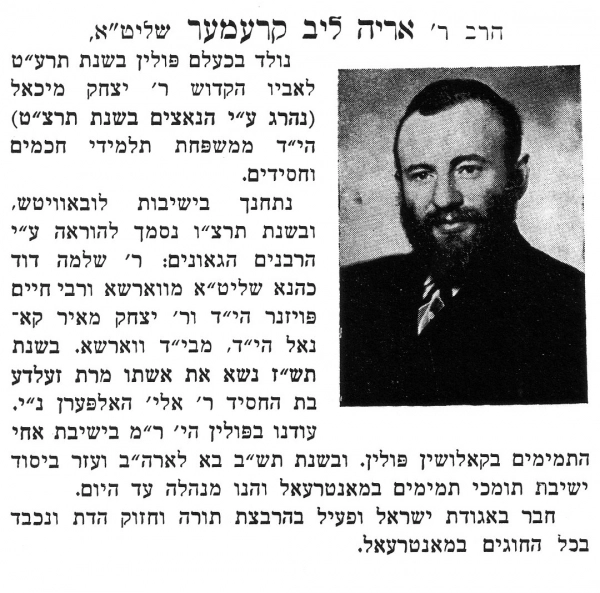 Le rabbin Aryeh Leib Kramer, un des neuf étudiants Lubavitch qui sont venus à Montréal en 1941 avec des visas japonais, était un fondateur du Collège…
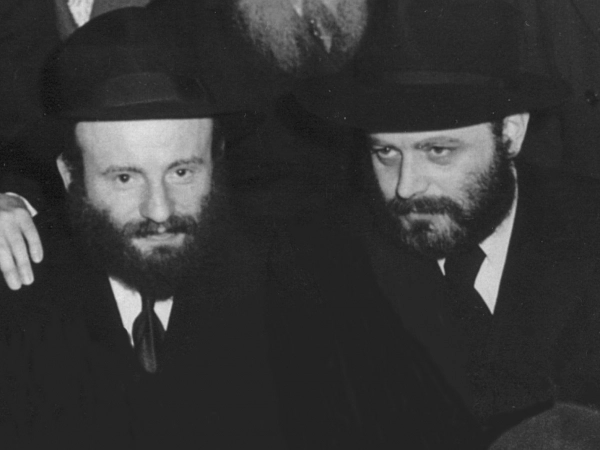 Le rebbe et rabbin Kramer: Le Rabbin Aryeh Leib Kramer avec le rebbe Lubavitch (ou dirigeant spirituel) Menachem Mendel Schneerson, vers les années 1950
 Le rabbin Aryeh Leib Kramer (numéro un sur l’image) au Collège rabbinique du Canada (Yeshiva Tomchei Temimim), 1957
 Le rabbin Aryeh Leib Kramer faisant la bénédiction sur le vin à un événement inconnu à Montréal, le 3 de kislev, 5709 (5 décembre, 1948)
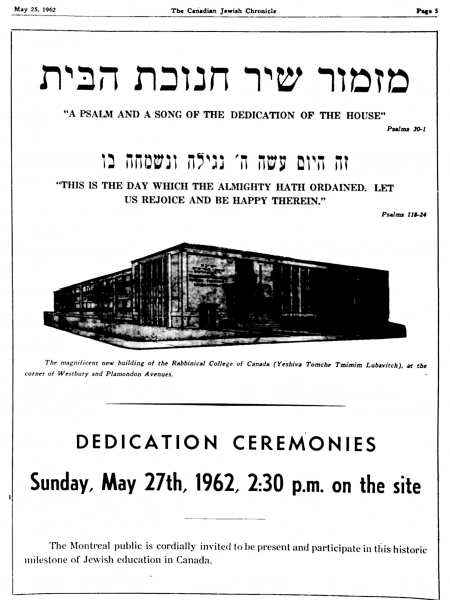 Annonce pour la dédicace du bâtiment du Collège rabbinique du Canada (Yeshiva Tomchei Tmimim) au coin de Plamondon et Westbury
Where
Not on the map yet.
- Held by
- Museum of Jewish Montreal via Museum of Jewish Montreal — map of Jewish Montreal
- Dates
- 1941-2015 (indexed as 1941–2015)
- Level
- collection (source: Story)
- Extent
- 3 places
- Scope & content
- Lubavitch (or Chabad) Hasidism was founded in 1773 in Russia by Shneur Zalman of Liadi. Unlike other Hasidic groups that focus on an emotional experience of God, the Lubavitch emphasize a more intellectual approach to worship. They also stand out for their active outreach activities, through which they seek to lead secular Jews to Orthodox practice. In Montreal, the Lubavitch community was originally associated with Menashe Lavut, a Russian immigrant from the town of Nikolaev who came to Canada in 1905. Around 1910, Lavut founded the Anshei Chabad Lubavitch group, as well as the Beys Medresh Nusach Ha’Ari synagogue and study hall. The Lubavitch were among the first Hasidic groups in Montreal. Yet while the city is now home to a sizable Hasidic population, the major influx of Hasidic Jews dates only to the end of the Second World War. Indeed, it was not until 1941 that Montreal’s Lubavitch community saw significant growth, prompted by the arrival of nine students fleeing the Nazi regime and the war in Europe. Most were from the Tomchei Temimim yeshiva in Otwock, a suburb of Warsaw, Poland. The students managed to obtain visas to immigrate to Japan, and eventually came to Canada via Shanghai in 1941. It was an exceptional event in the wartime context, when Jewish immigration to Canada was all but shut down. Readers of the Yiddish press eagerly awaited the young Jews, and the Yiddish newspaper Der Keneder Adler gave their arrival special coverage, reporting on the various steps in their journey from Shanghai to Montreal. The nine students decided to provide their Lubavitch group with a separate yeshiva, promptly opening it in the basement of the Nusach Ha’Ari synagogue on Pine Avenue. Its launch marked the start of the more official development of the Lubavitch community. With some twenty-five students in its first year, the synagogue went on to welcome two hundred the next. In 1943, the institution moved to a new building on Park Avenue. Known today as the Rabbinical College of Canada or Yeshivas Tomchei Temimim Lubavitch , it is currently located on Westbury in the Côte-des-Neiges district of Montreal. Sources: Lapidus, Steven, The Forgotten Hassidim: Rabbis and Rebbes in Prewar Canada, Revue Canadian Jewish Studies/Études juives canadiennes 12 : 1-30, 2004. Print Shaffir, William, Life in a Religious Community: The Lubavitcher Hassidim in Montreal, Toronto, Holt, Éditions Rinehart and Winston of Canada Limited, 1974. Print. Weinfeld, Shaffir and Irwin Cotler. The Canadian Jewish Mosaic, Rexdale, Éditions John Wiley & Sons, 1981. Print. * Images courtesy of Neil Folberg, Dr. Steven Lapidus, and www.rabbikramerslegacy.com
- Location
No place found in this description yet.
- Subjects
- Religious
- Language
- English
- Harvested
- 2026-10-17T06:33:36Z · source datestamp n/a · mjm