- Museum of Jewish Montreal
- Reuben Brainin
Reuben Brainin
collection1912-1917
12 of 17 descriptions below digitizedOpen enclosing description at source ↗
This description was harvested from its parent's finding aid, but the source catalogue gave no direct link for it. The link opens the nearest enclosing description; look there for Reuben Brainin.
Digitized below this collection
12 images · displayed from Museum of Jewish Montreal's own server
 Reuben and his wife Masha
 Brainin and his sons who were enlisted in the Jewish Legion during the First World War
 Reuben and Masha Brainin with their children
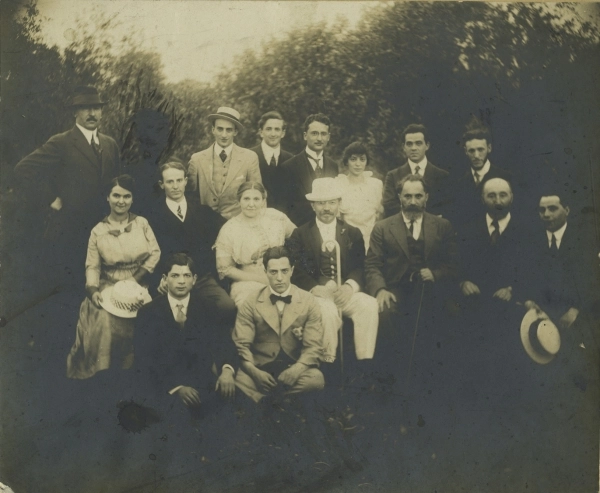 Group portrait with (first row, r to l) Moe Brainin, Hershl Reisler, (second row) M. Stein, J. Yawpolsky, Reuben Brainin, Sholom Aleichem, Mrs
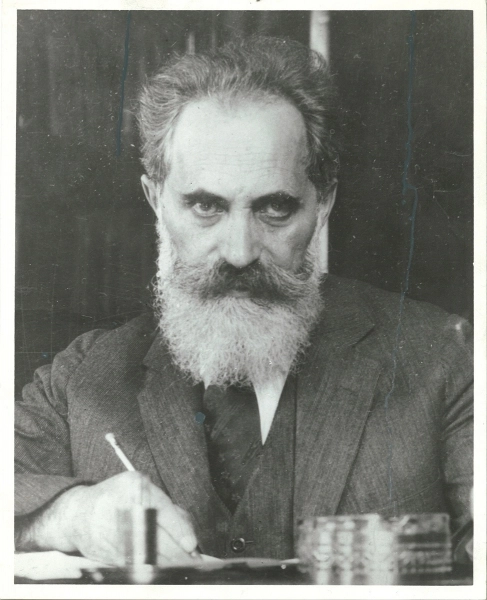 Portrait, Reuben Brainin. ca. 1900s
 David Rome examining the Reuben Brainin Archives, including Brainin's Hebrew typewriter. ca. 1950s
 Gravesite of Reuben Brainin. Photo shows many people gathered in front of grave. Montreal, 1962
 Photograph of portrait painting of Reuben Brainin by F. Horowitz
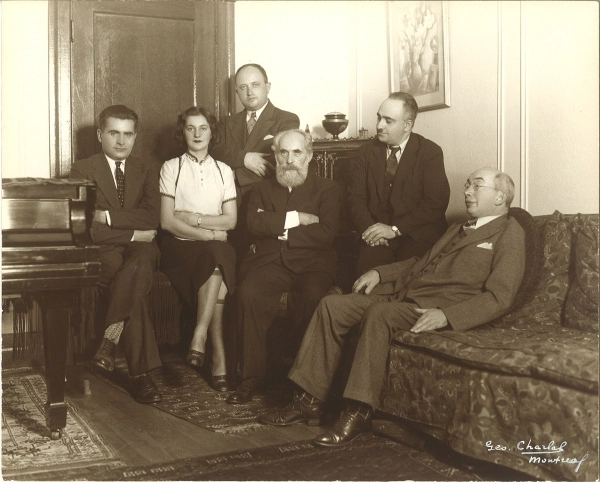 Reuben Brainin (Hebraist, writer and editor of Hebrew and Yiddish) on a visit to Montreal, together with local authors, ca. 1930s
 Outdoor rally in Tel- Aviv, British-mandate Palestine, with Reuben Brainin in the centre, ca.1928
 Reuben Brainin addressing rally in Tel-Aviv. Photo shows Brainin on stage at a podium facing a large crowd, ca.1928
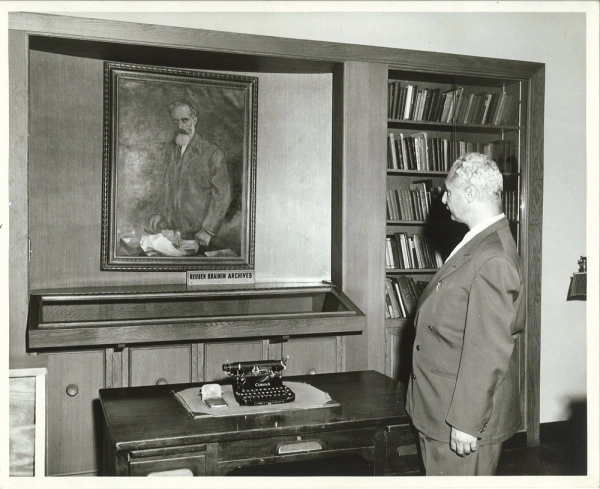 David Rome examining the Reuben Brainin Archives, including Brainin's Hebrew typewriter. 1950s
Where
Not on the map yet.
- Held by
- Museum of Jewish Montreal via Museum of Jewish Montreal — map of Jewish Montreal
- Creator
- Richard Kreitner
- Dates
- 1912-1917 (indexed as 1912–1917)
- Level
- collection (source: Story)
- Extent
- 5 places
- Scope & content
- Reuben Brainin, Hebraist, writer and editor of Hebrew and Yiddish newspapers, was born in 1862 in Liady (present-day Belarus), the town of Rabbi Schneur Zalman, the founder of Chabad Lubavitch . Brainin studied in nearby Vitebsk, first reading traditional religious texts and then more secular and Zionist works related to the Haskalah (Jewish Enlightenment). He later moved to Vienna, where he became an increasingly prominent figure in Jewish intellectual life, writing prolifically and editing a journal. It was there that he became an early convert to Herzlian Zionism. He continued to edit Hebrew and Yiddish intellectual journals, translate, and produce his own works after relocating to Berlin in 1896. When Brainin moved to New York in 1910, he was one of the world’s most prominent proponents of the Hebrew language. In 1912, Brainin moved again to Montreal, where he began a three-year stint editing the Yiddish-language community paper Keneder Adler and thereafter the rival daily Der Veg , which was formed to challenge the more affluent, assimilationist members of the Jewish community, and to support the creation of a national Jewish congress. Brainin became involved in community politics, including labour strife in 1914 (during which he acted as a mediator between the two sides), and refugee relief efforts during World War I. Along with Yehudah Kaufman, Brainin opened a Jewish reading room in 1914, which eventually became Montreal’s renowned Jewish Public Library . In that same year, he also played an important role in creating the Yidishe Folks Shule (Jewish People’s School) . For the fledgling Montreal Jewish intellectual community, Brainin was a central figure, a pioneer, and an inspiration to the generations of writers who would, in the ensuing decades, make the community the locus of Jewish literary activity it eventually became. In 1916, Brainin returned to New York to edit the Hebrew journal Ha-Toren . He remained influential until a public dispute in the late 1920s over his support of Jewish settlement in Soviet Birobidzan. This led to a failed lawsuit against Chaim Nachman Bialik and his complete estrangement from the Hebraist-Zionist movement. Brainin then turned almost exclusively to writing in Yiddish. Though based in New York, he kept close ties to Montreal, where his children resided, and he often spent summers in the Laurentians. He died in 1939, with the request that he be buried in Montreal, and that his books be donated to the Jewish Public Library, where his archive still exists. Compiled by Richard Kreitner Sources: August, David. The genesis period of the Jewish People’s School in Montreal. Masters Thesis. Concordia University, Montreal, 1975. Print. Caruso, Naomi. Reuven Brainin: The Fall of an Icon. Montreal: Canadian Jewish Congress Charities Committee, 2007. Print. Margolis, Rebecca. Jewish Roots, Canadian Soil: Yiddish Culture in Montreal, 1905-1945. Montreal: McGill-Queen's University Press, 2011. Print. Margolis, Rebecca E. Yiddish Literary Culture in Montreal, 1905-1940. Ann Arbor, Michigan: UMI, 2005. Print. Orenstein, Eugene. “Yiddish Culture in Canada Yesterday and Today,” in The Canadian Jewish Mosaic. Toronto: John Wiley and Sons, 1981. Print. Rome, David. The Canadian Story of Reuben Brainin, Part 1. Montreal: Canadian Jewish Archives, 1993. print. Rome, David. The Canadian Story of Reuben Brainin, Part 2. Montreal: Canadian Jewish Archives, 1996. Print. Srebrnick, Henry Felix. Jerusalem on the Amur: Birobidzan and the Canadian Jewish Communist Movement, 1924-1951. Montreal: McGill-Queens UP, 2008. *Images courtesy of the JPL-A, with a special thanks to Judy King Fonds.
- Location
No place found in this description yet.
- Subjects
- Literature
- Language
- English
- Harvested
- 2026-10-17T06:33:35Z · source datestamp n/a · mjm