- Museum of Jewish Montreal
- Folkskukhe (People's Kitchen)
Folkskukhe (People's Kitchen)
collection1907-1935
7 of 9 descriptions below digitizedOpen enclosing description at source ↗
This description was harvested from its parent's finding aid, but the source catalogue gave no direct link for it. The link opens the nearest enclosing description; look there for Folkskukhe (People's Kitchen).
Digitized below this collection
7 images · displayed from Museum of Jewish Montreal's own server
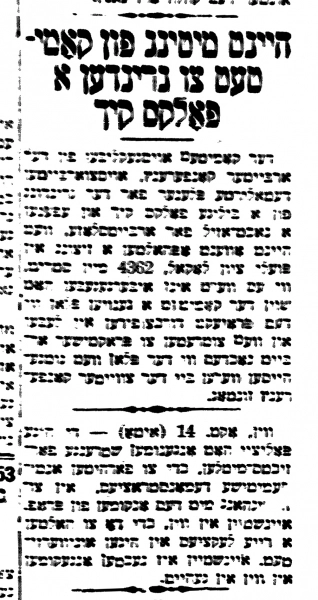 Cet article du 15 octobre 1931 dans le Keneder Adler, le journal yiddish de Montréal, rapporte qu’« aujourd’hui, un comité travaille à l’organisation d’une…
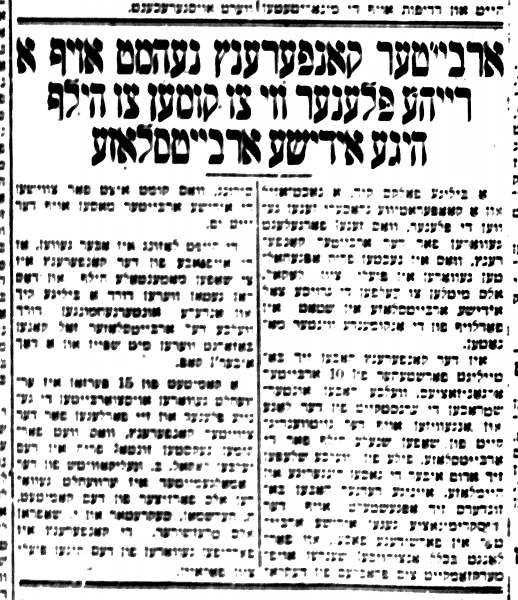 Cet article du 12 octobre 1931 dans le Keneder Adler, le journal yiddish de Montréal, rapporte que « La convention des travailleurs aura lieu afin de mettre…
 Encart dans le Rapport annuel de la Fédération dans les années 1920 ou 1930 encourageant les employeurs à afficher les postes vacants auprès du bureau de…
 Un article du 7 mars 1908 dans le journal Jewish Times à propos de la première People’s Kitchen (soupe populaire)
 Cet article du 16 octobre 1931 dans le Keneder Adler, le journal yiddish de Montréal, fait référence aux « préparations pour la Folks Kitchen (soupe populaire)…
 Harry Mayerovitch, L'Oeuvre de la Soupe, Vers 1935, Huile sur panneau de fibre de bois, 26 x 61 cm, Maintenant au Musée national des beaux-arts du Québec
 Refuge Meurling au 435, rue Champ-de-Mars. File d'attente de chômeurs devant l'entrée du refuge lors de la crise économique des années 1930
Where
Not on the map yet.
- Held by
- Museum of Jewish Montreal via Museum of Jewish Montreal — map of Jewish Montreal
- Creator
- Marian Pinsky
- Dates
- 1907-1935 (indexed as 1907–1935)
- Level
- collection (source: Story)
- Extent
- 2 places
- Scope & content
- When living standards for the average working-class citizen deteriorated during years of economic crisis, Jewish community organizations were hard-pressed to meet growing needs for services, food and employment. One of the most innovative initiatives was the Folkskukhe or “People’s Kitchen,” which had at least two incarnations. More than just a soup kitchen, these short-lived organizations worked to provide unemployed Jews with assistance and dignity during the most straining times. The first incarnation of the Folkskukhe (spelled Volkskueche in some sources) came during the Panic of 1907, which lasted through the winter and spring of 1908. Many of the recently immigrated Jews were already desperately poor and had little safety net during the recession that ensued. Louis Elstein, an anarchist active in Montreal’s syndicalist movement, ran a radical book store located at 12 Ontario Street East. In a small space adjoining the book store, or perhaps in the store itself (the Folkskukhe was listed at 10 Ontario Street East), a soup kitchen was set up by a group of radical young Jewish men and women. The Jewish Times, a newspaper published at the time by established “uptowner” Jews, which generally frowned upon the political and secularist views of radicals, was impressed by the care, respect and energy of those running the Folkskukhe, as well as the fact that the food served was kosher. Another Folkskukhe would appear two decades later in response to the Great Depression. As unemployment skyrocketed during the 1930s, the Keneder Adler (Montreal’s main Yiddish newspaper) and the Canadian Jewish Chronicle launched a campaign to raise $5,000 for an emergency relief fund for the jobless. Despite the hard times, the Jewish community, now more organized, contributed to helping the most vulnerable. In October 1931, in anticipation of a difficult winter, fifteen Jewish labour organizations collaborated to establish a soup kitchen to meet growing demands for tzedakah (charity). Volunteers assisted in distributing soup, meat and tea to unemployed workers, giving 10,000 meals to the needy in 1931 and another 30,000 in the first four months of 1932. Located on Mount Royal Avenue just west of St. Lawrence Boulevard, the Jewish People’s Restaurant for the Unemployed, also known as the Folkskukhe, distributed inexpensive but nutritious meals, initially for unemployed men, and soon followed by their wives and children. Few records exist for the Folkskukhe, but oral histories mention a “big, happy-go-lucky guy” named Pinye Morantz, who helped run the soup kitchen. The community’s difficulty in keeping up with the increasing need led to the Federation of Jewish Philanthropies running ads in the Canadian Jewish Chronicle, encouraging employers to hire Jewish workers. In spite of the strain this placed on the community’s philanthropic associations, people seeking assistance were granted dignity, not simply charity. Compiled by Marian Pinsky Sources: Asher, Stanley, and Dov Okouneff. "Montreal Jewish Memories.", Montreal Jewish Memories. Web. 01 Dec. 2010. Cooper, John. Eat and Be Satisfied: a Social History of Jewish Food. Northvale, NJ: Jason Aronson, 1993. Rome, David. Men of the Yiddish Press. Montreal: National Archives, Canadian Jewish Congress, 1989. Rosenberg, M. Michael, and Jack Jedwab. "Institutional Completeness, Ethnic Organizational Style and the Role of the State: the Jewish, Italian and Greek Communities of Montreal." Canadian Review of Sociology/Revue Canadienne De Sociologie 29.3 (1992): 266-87. Tulchinsky, Gerald. Branching Out: the Transformation of the Canadian Jewish Community. Toronto, Canada: Stoddart, 1998. Tzuk, Yogev. "Challenge and Response: Jewish Communal Welfare in Montreal." Contemporary Jewry 6.2 (1983): 43-52. "What's Bred in the Bone." The Jewish Times [Montreal] 7 Mar. 1908: 2-3. Zeitz, Mordecai E. The History of the Federation of Jewish Philanthropies of Montreal. Ann Arbor: University of Michigan, 1974. Images courtesy of Musee national des beaux-arts du Quebec, Jewish Public Library-Archives and Archives de la ville de Montreal.
- Location
No place found in this description yet.
- Subjects
- Communal
- Language
- English
- Harvested
- 2026-10-17T06:33:27Z · source datestamp n/a · mjm